Autotrack
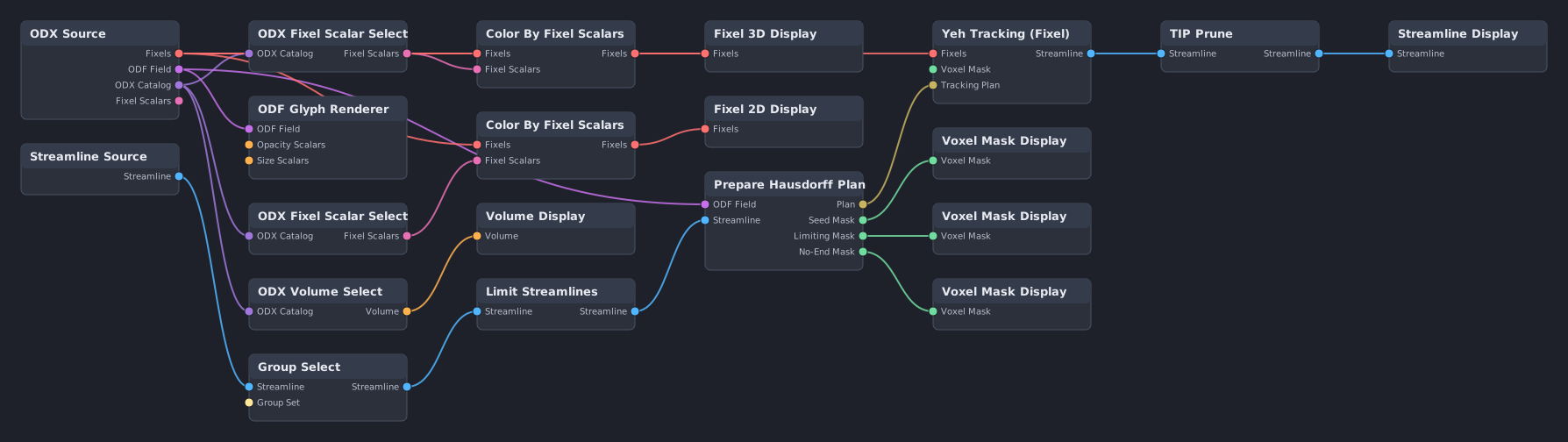
A saved autotrack workflow. Loaded from the checked-in JSON via the tolerant project loader and laid out by the same engine that renders the programmatic examples above.
What this workflow does
This is the kind of plan you'd run to reproduce a known bundle in a new subject: prepare a Hausdorff-shape plan from a reference tractogram, then seed deterministic tracking from the resulting masks.
A few things to look at in the diagram:
- Two parallel branches feed the plan. The reference bundle and the reconstruction's primary peaks are independent inputs — the plan node combines them to produce the seed mask, the limiting region, and the no-end mask in one pass.
- The tracking node consumes all three masks at once. The fixel tractography op takes the full plan as a single input port, not three separate ones, so the diagram stays readable as the plan grows.
Methods boilerplate
Rendered from the runtime methods-report generator for this workflow. Citation keys resolve to footnotes via mkdocs-bibtex; running the raw markdown through Pandoc + the project's citations.bib gives the same result for an exported paper.
Not the authoritative implementation. TRXViz provides re-implementations or ports of the methods referenced below. These implementations are NOT the authoritative versions — for the canonical implementations, please use the original software packages. Any differences in behavior or bugs are the responsibility of TRXViz, not the original authors. The presence of a citation here indicates only that TRXViz uses a method derived from that work and that users should credit the original authors; it does not imply that the original authors have reviewed, contributed to, or endorsed TRXViz.
Methods
The following analysis was performed using TRXViz 1. A tractography plan was prepared from a reference bundle following the DSI Studio shape-analysis approach 2, using a 12.0-mm Hausdorff tolerance to define the limiting region, a 2.0-mm seed dilation, and primary-peak Otsu factors of 0.50 (seed mask) and 0.90 (no-end mask); up to 20000 reference points were retained. Fixel-based deterministic tractography was performed following the DSI Studio approach 34 with augmented tracking strategies 2 to improve reproducibility, using a 1.00-mm step size, a maximum turning angle of 60°, length bounds of 10–300 mm, a fixel threshold of 0.05, and a smoothing fraction of 0.25; seeding targeted 30000 streamlines (up to 10000000 seed attempts).
-
Matthew Cieslak. Trxviz: interactive visualization and analysis for streamline and odf data in the trx/odx formats. TODO: finalize author list, Zenodo DOI, and version-specific citation. URL: https://github.com/PennLINC/TRXViz. ↩
-
Fang-Cheng Yeh. Shape analysis of the human association pathways. NeuroImage, 223:117329, 2020. doi:10.1016/j.neuroimage.2020.117329. ↩↩
-
Fang-Cheng Yeh. Dsi studio. Nature Methods, 2025. TODO: update full author list and pagination. doi:10.1038/s41592-025-02762-8. ↩
-
Fang-Cheng Yeh, Timothy D. Verstynen, Yibao Wang, Juan C. Fernández-Miranda, and Wen-Yih Isaac Tseng. Deterministic diffusion fiber tracking improved by quantitative anisotropy. PloS ONE, 8(11):e80713, 2013. doi:10.1371/journal.pone.0080713. ↩